The best power banks for laptops
The number on the front of a power bank is capacity. The number that decides whether it charges a laptop is output wattage, and most banks do not publish it loudly.
By Michael W. · Last updated October 17, 2026

We earn a commission when you buy through our links, at no extra cost to you. It never changes what we pick or how we rank it. How we’re funded.
To charge a laptop from a battery you need a power bank with USB-C Power Delivery of at least 60 watts, and the only one here that clears that bar is the Anker 25K / 165W laptop bank - 92.4 watt-hours, which is just inside the 100 Wh limit airlines cap spare batteries at. Everything smaller will trickle a laptop at best.
The reason most power banks cannot do this is a units problem. A bank is marketed on capacity in milliamp-hours, and a laptop cares about output in watts. A typical 10,000 mAh bank outputs 18 to 22.5 W, which is roughly a quarter of what a 13-inch laptop draws while running. Plug it in and the battery percentage goes down more slowly; it does not go up.
100 Wh is the number the airline checks
Spare lithium batteries are allowed in carry-on only, up to 100 watt-hours without approval, 100-160 Wh with airline approval, and never above 160 Wh. Convert with Wh = mAh / 1000 x 3.7, so 25,000 mAh is about 92.5 Wh and 30,000 mAh is about 111 Wh - over the free limit. Never in a checked bag. Full detail: power bank rules for flights.
Quick picks
The short list. Tap any row for the full write-up, including what each one is bad at.
| # | Product | Best for | Price |
|---|---|---|---|
| 1 | 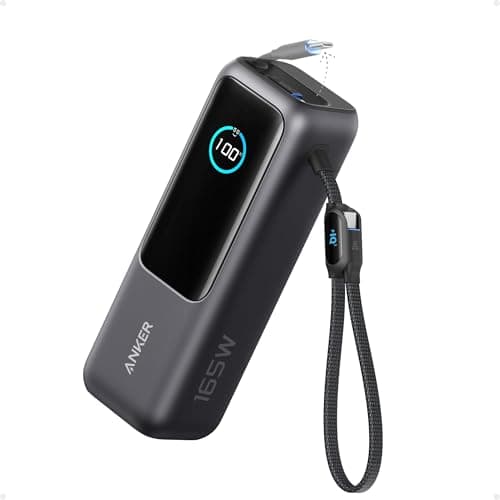 Anker Laptop Power Bank (25K, 165W) 165 W of USB-C output and 92.4 Wh of capacity - a real laptop charge, inside the airline limit. | Working away from a socket on a long travel day | $119.98View on Amazon #ad Price as of November 3, 2026. How we’re funded |
| 2 | 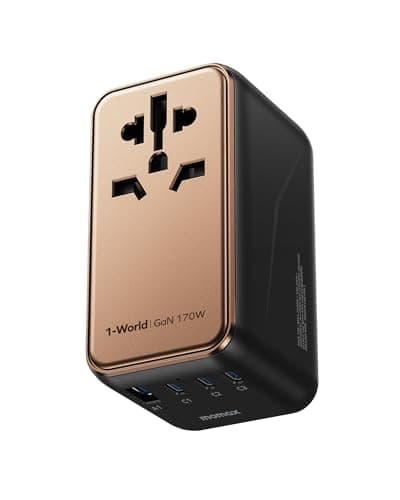 MOMAX 170W GaN Universal Travel Adapter 170 W of mains charging in one worldwide plug - lighter, cheaper and faster than any battery. | Anyone whose laptop only needs charging overnight | $66.49$99.9934% offView on Amazon #ad Price as of November 3, 2026. How we’re funded |
| 3 | 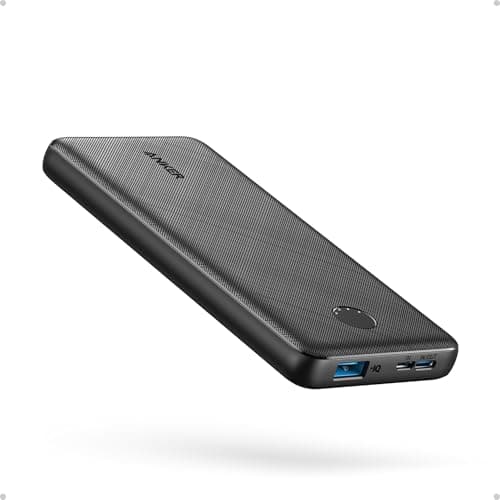 Anker PowerCore Slim 10000 Power Bank Three phone charges in a jacket pocket, at about 37 Wh - and it will not meaningfully charge a laptop. | The phone, not the laptop | $20.89$25.9920% offView on Amazon #ad Price as of November 3, 2026. How we’re funded |
The only format here that genuinely charges a laptop
Anker Laptop Power Bank (25K, 165W)
This is the pick if your laptop has to stay alive through a long-haul flight with no seat power, or a day of trains and airports. 165 W is more output than most laptop chargers supply, so it charges while you work rather than holding the level. The 92.4 Wh capacity is deliberate design: it is the largest useful size that sits under the 100 Wh threshold airlines allow with no approval at all.
The specs that decide it
- Output: 165 W total USB-C Power Delivery - enough to charge while in use
- Capacity: 25,000 mAh, about 92.4 Wh
- Flight rule: Under 100 Wh, so no airline approval needed - carry-on only
- Laptop charges: Roughly one full charge for a 13-inch ultraportable
Flaws but not dealbreakers
It is heavy and it is expensive - this is close to a pound and a half of battery, and on a trip where you will have mains power every night it is weight you carried for nothing. Charging it back up also takes a high-wattage charger, which is a second thing to pack.
#ad Price as of November 3, 2026. How we’re funded
The honest answer for most laptop travellers
MOMAX 170W GaN Universal Travel Adapter
Be honest about where your laptop actually runs flat. If it is at the hotel and not at 35,000 feet, a high-wattage GaN charger with worldwide plugs is the better buy by a wide margin: it is lighter than the battery, it charges the laptop and the phone and the tablet at once, and it has no watt-hour rule attached to it because it holds no charge. It also replaces the laptop's own bulky brick.
The specs that decide it
- Output: 170 W across multiple ports - laptop plus phone plus tablet
- Plugs: Worldwide, so it is also the travel adapter
- Flight rule: None - it stores no energy
- Replaces: The laptop's own charger and a separate plug adapter
Flaws but not dealbreakers
It does nothing at all without a socket, which is the entire scenario the laptop power bank exists for. Universal adapters are also chunky in a wall socket and can hang loose in a worn European outlet, which is worth checking before you walk away from it overnight.
#ad Price as of November 3, 2026. How we’re funded
The one for the device that actually dies first
Anker PowerCore Slim 10000 Power Bank
Worth saying plainly: this is not a laptop bank, and we are including it because for most people the laptop is not the device that runs out. The phone is - it is doing boarding passes, maps, tickets and a hotspot all day. A 10,000 mAh bank at about 37 Wh is three phone charges, weighs almost nothing and is far below any airline threshold.
The specs that decide it
- Capacity: 10,000 mAh, about 37 Wh
- Output: Phone-class - roughly 18-22.5 W
- Laptop: No. It will slow the drain, not reverse it
- Flight rule: Far inside the 100 Wh limit - carry-on only, as with all banks
Flaws but not dealbreakers
Its limit is the whole point of the page: plugged into a working laptop it is a drip feed, not a charge. If the laptop is the problem, this is the wrong product.
#ad Price as of November 3, 2026. How we’re funded
How the three compare
| Pick | Output | Capacity | Charges a laptop | Airline approval |
|---|---|---|---|---|
| Anker 25K / 165W | 165 W | 92.4 Wh | Yes | None needed - under 100 Wh |
| MOMAX 170W GaN adapter | 170 W from mains | No battery | Yes, with a socket | Not applicable |
| Anker PowerCore Slim 10000 | 18-22.5 W | About 37 Wh | No | None needed |
Why milliamp-hours are the wrong number
Capacity tells you how much energy a bank stores. Output tells you how fast it can hand that energy over. A laptop running a browser and a video call draws somewhere between 30 and 65 watts continuously, and a thin-and-light charging from empty will accept 45 to 100 W. A bank that can only push 20 W is working at a third of the rate the machine is consuming.
- Look for a published USB-C Power Delivery figure of 60 W or more. 30 W will charge a very efficient laptop slowly while it is asleep.
- One port at 100 W is not the same as four ports at 25 W. Check the per-port figure, not the total.
- The cable matters: a 60 W-plus charge needs a cable rated for it. A phone cable will cap the handshake low.
Converting capacity to watt-hours
| Capacity | Watt-hours | Airline status |
|---|---|---|
| 5,000 mAh | About 18.5 Wh | Fine, carry-on only |
| 10,000 mAh | About 37 Wh | Fine, carry-on only |
| 20,000 mAh | About 74 Wh | Fine, carry-on only |
| 25,000 mAh | About 92.5 Wh | Fine - the largest easy size |
| 30,000 mAh | About 111 Wh | Airline approval required (100-160 Wh) |
| 50,000 mAh | About 185 Wh | Prohibited - over 160 Wh |
Two rules apply to every row: spare batteries travel in the cabin, never in the hold, and a growing number of carriers now also prohibit using a power bank in flight while still allowing you to carry it. Both are covered in power bank rules for flights.
Which one to actually pack
The decision is about sockets, not about batteries.
- Seat power on the flight, mains at the hotel: take the GaN charger only. A laptop bank is a pound and a half of dead weight.
- Long-haul in a cabin with no power, and you need to work: take the 25K bank. This is the one scenario that justifies it.
- A day of trains, buses and airports: take the phone bank. The phone is the device doing the work.
- A conference or a work trip abroad: the GaN adapter plus the phone bank covers almost everything for less weight than the laptop bank alone.
If the trip is international, the adapter question is separate and worth getting right - start with best travel adapters, and note that an adapter is not a voltage converter.
Frequently asked questions
Can a power bank charge a laptop?
What size power bank can you take on a plane?
Is a travel charger better than a laptop power bank?
Read next
- Best power banks for travel
- Best power banks for international travel
- Power bank rules for flights
- Best travel adapters
- Best electronics organizers for travel
- Best carry-on luggage with a laptop compartment
More in Travel Essentials, or see every roundup and comparison on the site.