The best power banks for international travel
Power banks are measured one way on the box and another way by the airline. Here is the conversion that matters, and four picks that stay inside it.
By Michael W. · Last updated October 11, 2026
We earn a commission when you buy through our links, at no extra cost to you. It never changes what we pick or how we rank it. How we’re funded.
For most international trips the right power bank is a 10,000 mAh unit of about 37 watt-hours - the Anker PowerCore Slim 10000 - because it is three phone charges, it is comfortably under every airline threshold, and it fits in a jacket pocket. The single rule to know is that power banks are banned from checked baggage worldwide: they travel in the cabin, with you, every time.
The number airlines care about is watt-hours (Wh), not the milliamp-hours printed on the box. Under 100 Wh needs no approval. 100 to 160 Wh needs airline permission in advance. Over 160 Wh is prohibited. To convert: multiply the mAh by the cell voltage - 3.7 V for almost every power bank - and divide by 1,000. A 10,000 mAh bank is about 37 Wh, and a 27,000 mAh bank is about 100 Wh, which is where the paperwork starts.
Never in the hold
Lithium power banks are prohibited in checked baggage by every major carrier and regulator, because a thermal runaway in a cargo hold cannot be reached. If your carry-on gets gate-checked, take the power bank out first. Full detail in power bank rules for flights.
Quick picks
The short list. Tap any row for the full write-up, including what each one is bad at.
| # | Product | Best for | Price |
|---|---|---|---|
| 1 | 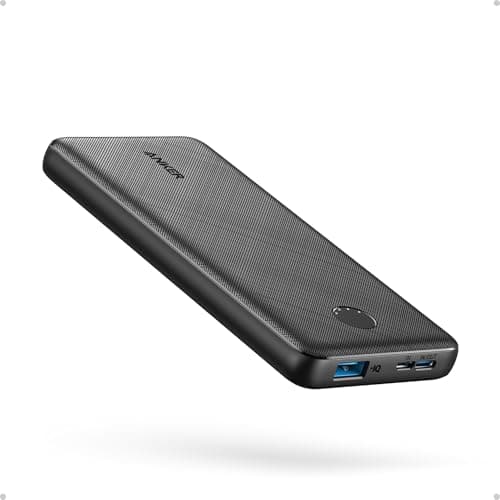 Anker PowerCore Slim 10000 Power Bank About 37 Wh - roughly a third of the no-approval limit, and two or three full phone charges. | Most international trips | $20.89$25.9920% offView on Amazon #ad Price as of October 10, 2026. How we’re funded |
| 2 | 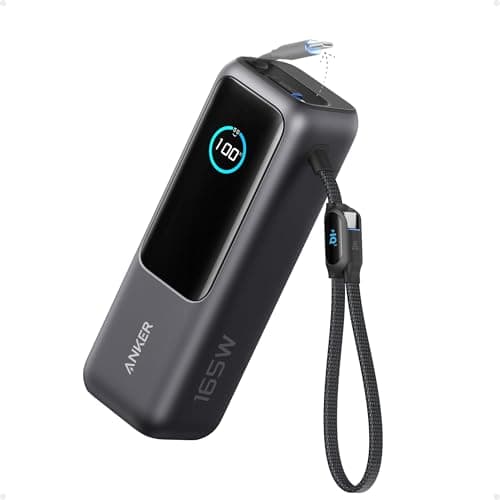 Anker Laptop Power Bank (25K, 165W) About 92 Wh - just inside the no-approval limit - with three 100 W USB-C ports. | Working trips and long-haul economy with no seat power | $119.98$134.9911% offView on Amazon #ad Price as of October 10, 2026. How we’re funded |
| 3 | 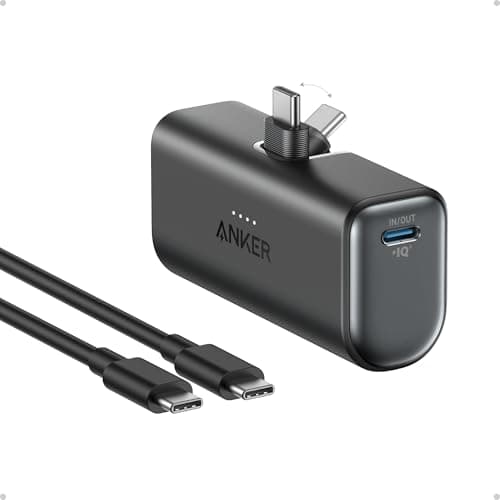 Anker Nano Power Bank (5,000 mAh) About 18 Wh and genuinely pocket-sized, which is the only reason it gets used. | Day trips and city walking | $29.99View on Amazon #ad Price as of October 10, 2026. How we’re funded |
| 4 | 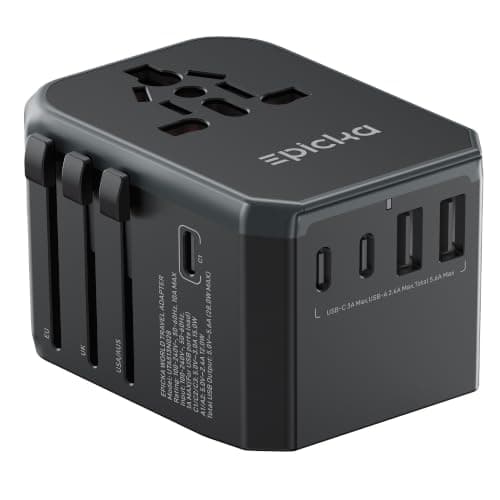 Epicka Universal Travel Adapter Covers the common plug types plus multiple USB ports, so one brick recharges everything overnight. | Any trip crossing plug standards | $19.99View on Amazon #ad Price as of October 10, 2026. How we’re funded |
The one that covers a long-haul day without paperwork
Anker PowerCore Slim 10000 Power Bank
This is the size that matches the actual problem abroad: a travel day where you are navigating, translating, holding boarding passes and photographing things for fourteen hours between two wall sockets you do not have an adapter for yet. At about 37 Wh it is nowhere near the 100 Wh threshold, so no airline anywhere needs to be asked about it, and it is small enough that it lives in a jacket pocket rather than in the bag you put in the overhead bin.
The specs that decide it
- Capacity: Roughly 37 Wh - well under the 100 Wh no-approval threshold
- Where it travels: Carry-on only. Power banks are prohibited in checked bags
- Output: Two or three full phone charges
- Abroad: No airline approval needed on any carrier
Flaws but not dealbreakers
It will not charge a laptop at any useful speed, and it recharges itself slowly - plan on it taking most of an evening from a hotel socket, which means remembering to plug it in rather than leaving it in the bag.
#ad Price as of October 10, 2026. How we’re funded
The one that runs a working day on a long-haul flight
Anker Laptop Power Bank (25K, 165W)
Long-haul economy seat power is unreliable and frequently absent, and a laptop will not run a transatlantic flight on its own battery. At 165 W total output across three USB-C ports this charges a laptop at close to mains speed while also handling a phone and headphones. At roughly 92 Wh it sits deliberately under the 100 Wh line, which is the whole design brief for a travel bank this size.
The specs that decide it
- Capacity: 25,000 mAh, roughly 92 Wh - under the 100 Wh threshold
- Output: Three 100 W USB-C ports, 165 W total - enough for most laptops
- Travels: Carry-on only, and check individual airline quantity rules
- Abroad: No approval needed, but it is close enough to the line to be asked about
Flaws but not dealbreakers
It is heavy and it is close to the limit, which means an inspector who wants to check the Wh rating on the case will occasionally do so - make sure the printed figure is legible and not hidden under a sticker. Several airlines also cap the number of spare batteries per passenger regardless of size.
#ad Price as of October 10, 2026. How we’re funded
The one you actually have on you in a city
Anker Nano Power Bank (5,000 mAh)
The best power bank abroad is the one in your pocket at 6pm, not the bigger one in the hotel safe. At about 18 Wh this is one full phone charge in something the size of a deck of cards - enough to get a navigation app and a transit ticket through the back half of a long day on foot, which is the failure mode that actually strands people in an unfamiliar city.
The specs that decide it
- Capacity: 5,000 mAh, roughly 18 Wh
- Output: About one full phone charge
- Size: Pocketable - the reason to choose it
- Abroad: Far under every threshold; no approval anywhere
Flaws but not dealbreakers
One charge is one charge. It is not enough for a travel day with a tablet, a camera and a phone, and it is nowhere near enough for a laptop. Treat it as a second bank rather than your only one on a long trip.
#ad Price as of October 10, 2026. How we’re funded
The thing that recharges the bank in the hotel
Epicka Universal Travel Adapter
A power bank abroad is only as good as your ability to refill it, and that is a plug problem rather than a battery problem. A universal adapter with several USB ports turns one unfamiliar wall socket into a charging station for the bank, the phone and a watch at the same time - which matters in European and Asian hotel rooms where there is frequently exactly one accessible socket.
The specs that decide it
- Covers: Most common plug types worldwide, including Europe's Type C and F
- USB: Multiple ports, which reduce how many bricks you pack
- Does not do: Voltage conversion. Check your device reads 100-240V
- Pairs with: Any of the banks above
Flaws but not dealbreakers
It is an adapter, not a converter: it changes the shape of the plug and nothing else. Anything that is not rated 100-240V - a few hair tools, some older appliances - will be destroyed by it, which is a different purchase entirely.
#ad Price as of October 10, 2026. How we’re funded
How the power banks compare
| Pick | Capacity | Approx. watt-hours | Airline approval | Main flaw |
|---|---|---|---|---|
| Anker PowerCore Slim 10000 | 10,000 mAh | About 37 Wh | None needed | Will not run a laptop |
| Anker 25K laptop bank | 25,000 mAh | About 92 Wh | None needed, near the line | Heavy; may be inspected |
| Anker Nano 5000 | 5,000 mAh | About 18 Wh | None needed | One phone charge |
| Epicka adapter | n/a | n/a | n/a | No voltage conversion |
The mAh to watt-hour conversion, in one line
Wh = (mAh x 3.7) / 1000. Almost every lithium power bank uses 3.7 V nominal cells, so that is the figure to use unless the case prints something else. The reason this matters is that airlines and regulators write their limits in watt-hours and manufacturers print milliamp-hours on the box.
| Capacity | Approx. watt-hours | Status |
|---|---|---|
| 5,000 mAh | 18 Wh | No approval needed |
| 10,000 mAh | 37 Wh | No approval needed |
| 20,000 mAh | 74 Wh | No approval needed |
| 25,000 mAh | 92 Wh | No approval needed |
| 27,000 mAh | 100 Wh | At the line - approval territory |
| 43,000 mAh | 160 Wh | Maximum, with approval |
Why they can never go in a checked bag
A lithium cell in thermal runaway produces its own oxygen, which means it cannot be smothered. In the cabin, crew have extinguishers, containment bags and eyes on it within seconds. In a cargo hold nobody reaches it at all. That asymmetry is the whole basis of the rule, and it applies on every airline in the world regardless of the bank's size.
The practical trap is the gate-check. If your carry-on is taken at the gate because the bins are full, the power bank has to come out of it first - and so does anything else on the prohibited list in what not to pack in checked luggage.
What changes on an international itinerary
- Quantity caps. Several Asian and Middle Eastern carriers limit the number of spare batteries per passenger even when each one is under 100 Wh. Two banks is almost always fine; five is not.
- Visible ratings. Some carriers require the Wh or mAh rating to be legible on the case. A bank whose printed label has worn off can be refused.
- In-flight use. A growing number of airlines now prohibit *using* or charging a power bank during the flight while still allowing you to carry it. Charge before boarding.
- Recharging. You need the right plug adapter at the other end, and a 100-240V rating on the charger. Nothing else recharges the bank.
If you are unsure which plug you need, best travel adapters covers the types by region and travel adapter vs voltage converter covers the mistake that destroys appliances.
How much capacity a trip abroad actually needs
Count devices and travel days rather than milliamp-hours. A modern phone is roughly 4,000 to 5,000 mAh, so a 10,000 mAh bank is about two full charges once conversion losses are taken out - not the 2.5 the arithmetic suggests.
One long-haul travel day with heavy navigation and photography is about one and a half phone charges. A 10,000 mAh bank covers that with margin. The only reasons to go bigger are a laptop, a camera that charges over USB-C, or a multi-day trip genuinely away from power - and the only reason to go smaller is that you will actually carry it.
Frequently asked questions
What size power bank is allowed on international flights?
Can a power bank go in checked luggage?
How many mAh is 100 watt-hours?
Can I charge a power bank on the plane?
Sources
Read next
- Power bank rules for flights
- Best power banks for travel
- Best travel adapters
- Travel adapter vs voltage converter
- What not to pack in checked luggage
More in Travel Essentials, or see every roundup and comparison on the site.