Carry-on luggage size by airline
The limits eight major US airlines actually publish, in inches and centimeters, with the carrier's own page linked for every figure.
By Michael W. · Last updated September 29, 2026
We earn a commission when you buy through our links, at no extra cost to you. It never changes what we pick or how we rank it. How we’re funded.
On most major US airlines a carry-on can measure up to 22 x 14 x 9 inches (about 56 x 36 x 23 cm), including wheels and handles. Southwest and Frontier allow more at 24 x 16 x 10 inches. Spirit allows 22 x 18 x 10 inches. Those three exceptions are the entire reason this page exists, because a bag bought against the wrong one of them is a bag you will be paying a gate fee for.
Verify with your airline before you fly
Baggage allowances change, they vary by fare class, and on a codeshare the operating carrier's rules usually apply rather than the airline you booked with. Every figure below links to the carrier's own baggage page - check it on the day. Use this table to choose a bag, not to argue with a gate agent.
One detail that catches more people than any other: the measurement includes wheels, the telescoping handle housing and any external pockets. Manufacturers routinely quote the case body only, which is how a suitcase marketed as a 21-inch carry-on turns up at 22.5 inches in a sizer. If you are buying online, look for a stated overall dimension, and if the listing only gives you one number, assume it is the optimistic one.
Carry-on limits by airline
| Airline | Carry-on (inches) | Carry-on (cm) | Weight limit | Personal item |
|---|---|---|---|---|
| American | 22 x 14 x 9 | 56 x 36 x 23 | None published (US domestic) | 18 x 14 x 8 in |
| Delta | 22 x 14 x 9 (45 linear in) | 56 x 35 x 23 | None published (US domestic) | No dimensions published |
| United | 22 x 14 x 9 | 56 x 35 x 23 | None published (US domestic) | 17 x 10 x 9 in |
| Southwest | 24 x 16 x 10 | 61 x 41 x 25 | None published | No dimensions published |
| JetBlue | 22 x 14 x 9 | 55.9 x 35.6 x 22.9 | None published | 17 x 13 x 8 in |
| Alaska | 22 x 14 x 9 (45 linear in) | 56 x 36 x 23 | None published | No dimensions published |
| Frontier | 24 x 16 x 10 | 61 x 41 x 25 | 35 lb | 18 x 14 x 8 in, 35 lb |
| Spirit | 22 x 18 x 10 | 56 x 46 x 25 | None published | 18 x 14 x 8 in |
American Airlines carry-on size
American allows one carry-on of up to 22 x 14 x 9 inches, plus one personal item of up to 18 x 14 x 8 inches. The carry-on allowance applies in all cabins, including Basic Economy on American - which is a meaningful difference from United and Delta, where Basic Economy strips the carry-on out entirely on most domestic routes.
American's personal item allowance is among the more generous published figures at 18 x 14 x 8, matching Spirit and Frontier. If you fly American often, that is a real planning advantage: an 18-inch under-seat bag is large enough to work as a genuine second bag rather than a laptop sleeve.
Delta carry-on size
Delta caps individual dimensions at 22 x 14 x 9 inches (56 x 35 x 23 cm) and also applies a 45 linear inch total - length plus width plus height. In practice the two constraints agree, since 22 + 14 + 9 is 45 exactly, so a bag that passes the individual measurements passes the linear one too.
Delta publishes no dimensions for the personal item. The requirement is that it fits under the seat in front of you, and the page lists examples - a purse, briefcase, small backpack, camera bag, diaper bag or laptop bag. That vagueness cuts both ways: there is no number to fail against, but there is also no number to appeal to if an agent decides your bag is too big.
United carry-on size
United allows 22 x 14 x 9 inches (56 x 35 x 23 cm) including handles and wheels, with a published personal item limit of 17 x 10 x 9 inches (43 x 25 x 22 cm). That personal item figure is the tightest of the eight carriers here, and it is the one to design your under-seat bag around if United is your regular airline.
United Basic Economy on most domestic routes includes the personal item only. A full-size carry-on brought to the gate on that fare gets checked for a fee. Check the fare rules on your specific ticket rather than the general baggage page - the allowance is set by fare class, not by airline.
Southwest carry-on size
Southwest publishes the most generous carry-on allowance of any major US carrier: 24 inches long by 16 wide by 10 high, with wheels, handles and attachments counting toward the measurement. That is two inches longer, two wider and one taller than the industry standard - a genuinely different bag size, not a rounding difference.
If you fly Southwest most of the time, the extra room is worth buying for. If you fly Southwest sometimes and other carriers the rest of the time, do not - a 24-inch bag is oversized on every other airline in this table, and you would be optimizing for the trip you take least often. Buy to the strictest limit you fly against regularly.
Southwest does not publish personal item dimensions; the requirement is that the item fits under the seat in front of you.
JetBlue carry-on size
JetBlue publishes 22 x 14 x 9 inches (55.88 x 35.56 x 22.86 cm) for the carry-on and 17 x 13 x 8 inches (43.2 x 33 x 20.32 cm) for the personal item, including wheels and handles. JetBlue is one of the few carriers to publish personal item dimensions to the centimeter, which makes it easy to check a bag's spec sheet against the rule before buying.
Note the shape of that personal item allowance: 13 inches wide but only 8 deep. Wide, flat bags clear it comfortably; chunky cube-shaped backpacks often do not, even when their stated volume is modest.
Alaska Airlines carry-on size
Alaska allows one bag of no more than 22 x 14 x 9 inches, or 45 linear inches, including wheels and handle. Alaska's own guidance is explicit that expandable pockets count toward the measurement as well - so if your bag has an expansion zip, measure it zipped shut and then resist using it on the way home.
Alaska publishes no personal item dimensions, listing categories instead - a purse, briefcase or laptop bag - that must fit under the seat.
Frontier carry-on size and weight
Frontier allows a carry-on of 24 x 16 x 10 inches and up to 35 lb, and a personal item of 18 x 14 x 8 inches and up to 35 lb, both including handles, wheels and straps. Frontier is one of the few US carriers to publish a carry-on weight limit at all, and it is the figure most people miss.
The generous dimensions are deceptive. On an ultra-low-cost carrier the carry-on is usually a paid add-on, and the personal item is the only free allowance - which is why the 18 x 14 x 8 figure matters far more here than the 24 x 16 x 10 one. Gate sizers are used, and they are used consistently.
Spirit carry-on size
Spirit publishes 22 x 18 x 10 inches (56 x 46 x 25 cm) for the carry-on and 18 x 14 x 8 inches (45 x 35 x 20 cm) for the personal item, including handles and wheels. The carry-on shape is unusual - the same 22-inch length as the standard, but far deeper and wider.
As with Frontier, the free allowance on most Spirit fares is the personal item only, so the 18 x 14 x 8 figure is the one that decides what you can bring without paying. Bags built specifically to that dimension have become a product category of their own, and they are worth considering if ultra-low-cost carriers are a regular part of how you travel.
Carry-on size for international flights
There is no global standard. IATA has published a suggested cabin bag guideline in the past, but it is advisory and airlines are free to ignore it - and most do. The practical pattern outside the US is that dimensions are broadly similar to the 22 x 14 x 9 standard, sometimes a centimeter or two tighter, but a weight limit is added, and it is enforced.
Cabin bag weight limits of 7 to 10 kg are common on European, Asian and Middle Eastern carriers. That changes the buying calculation completely: on a carrier that weighs cabin bags, an empty 9 lb hardside suitcase has already consumed more than half of a 7 kg allowance before you pack anything. If you fly internationally on carriers that weigh, the empty weight of the bag is the most important number on its spec sheet.
The other international quirk is the long-haul connection. A bag that cleared the limit on your transatlantic leg may be measured again, against stricter rules, by the regional carrier operating your connecting flight. On a single ticket that is still your problem to solve at the gate.
Do wheels and handles count?
Yes, on every carrier in this table. Southwest, Alaska, Frontier and Spirit state it explicitly; the others measure at the bag's widest points, which amounts to the same thing. Alaska additionally names expandable pockets.
This is where most gate disputes originate. A soft bag with a 22-inch body and a 1.5-inch wheel assembly is a 23.5-inch bag as far as the airline is concerned. Softside bags have an advantage here in that they compress into a sizer under a firm push, which is not a rule you can rely on but is a real difference in practice - see hardside vs softside luggage for where that flexibility does and does not help.
If you want to be certain, measure your packed bag at home with a tape, at its widest points, and compare it against the strictest airline you fly. A luggage scale is worth having for the same reason on carriers that weigh cabin bags.
Bags that fit these limits
Knowing the rule only helps if the next step is easy. These are the pages where we apply it:
- Best carry-on luggage - the main shortlist, every pick checked against the 22 x 14 x 9 standard.
- Best underseat carry-on bags - for the trips where the personal item is the whole allowance.
- Best personal item bags - sized for the under-seat space, including the 18 x 14 x 8 shape.
- Best budget carry-on luggage - the same constraint at a lower price point.
- Best travel backpacks - if you would rather carry than roll, and want to clear the same limit.
Quick picks
The short list. Tap any row for the full write-up, including what each one is bad at.
| # | Product | Best for | Price |
|---|---|---|---|
| 1 | 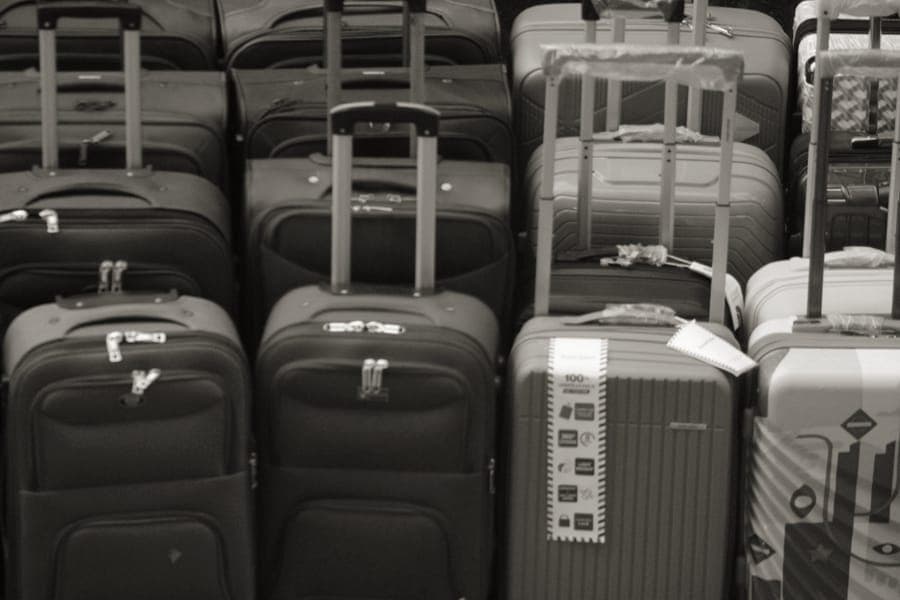 Travelpro Platinum Elite 21-inch Expandable Carry-On Spinner Built to the 22 x 14 x 9 standard, with the wheels and handle that outlast the shell. | Frequent flyers on mixed carriers | |
| 2 |  Amazon Basics 20-inch Hardside Spinner Undersized against the standard on purpose, which is exactly what you want at a strict gate. | Ultra-low-cost carrier flyers | |
| 3 |  Osprey Farpoint 40 Travel Pack Light enough that the 7 kg cabin allowance goes to your clothes rather than to the bag. | International and weight-capped flights |
The safe choice when you fly several different airlines
Travelpro Platinum Elite 21-inch Expandable Carry-On Spinner
If you fly American, Delta, United, JetBlue and Alaska in any combination, you want a bag designed against the 22 x 14 x 9 standard rather than one designed against Southwest's more generous figure. This is the softside benchmark in that category, and its reputation rests on the parts that actually fail - the wheel housings and the telescoping handle - rather than on the fabric.
The specs that decide it
- Clears: The 22 x 14 x 9 standard on American, Delta, United, JetBlue and Alaska
- Construction: Softside, which compresses slightly in a gate sizer where a hardshell will not
- Expansion: Expandable - but note that Alaska counts expansion toward the measurement
Flaws but not dealbreakers
Use the expansion zip and the bag is no longer carry-on legal. It is genuinely useful for the trip home with a checked bag, and a trap if you forget you opened it. Softside also means the shell offers less protection if it does get gate-checked.
The one to buy if you fly Spirit and Frontier and expect the sizer
Amazon Basics 20-inch Hardside Spinner
On an ultra-low-cost carrier the sizer is a revenue instrument and it will be used. Buying a bag that is comfortably inside the limit rather than exactly at it is the cheapest insurance available, and at this price the bag owes you nothing after a few trips. A 20-inch case clears every carrier in the table above with margin to spare.
The specs that decide it
- Clears: Every carrier in the table above, with margin
- Construction: Hardside, so it holds its shape in an overhead bin
- Trade-off: Smaller than the maximum legal size - less capacity by design
Flaws but not dealbreakers
You are giving up real capacity to buy margin. On a carrier that would have accepted a full-size 22-inch bag, that is volume you paid for and did not use. Budget hardside shells also scuff quickly, so it will look secondhand fast.
The bag for international carriers that weigh your cabin bag
Osprey Farpoint 40 Travel Pack
On carriers that weigh cabin baggage - common across Europe, Asia and the Middle East - the empty weight of the suitcase is the single most important number on its spec sheet. A wheeled hardside case can consume half of a 7 kg allowance before you pack anything. A frameless travel pack does not, and it compresses into a sizer in a way a rigid case cannot.
The specs that decide it
- Clears: The 22 x 14 x 9 envelope, and compresses further under a sizer
- Why it matters: Empty weight comes straight out of a 7-10 kg cabin allowance
- Carry: Harness stows away, so it can be checked without straps catching
Flaws but not dealbreakers
You are carrying it, not rolling it. Across a long terminal with a full load that is a real difference, and it is the wrong choice entirely if you have back or shoulder problems. There is also no way to set it down and lean on it.
Frequently asked questions
What size is a carry-on bag?
Do wheels and handles count toward carry-on size?
Is a 24-inch suitcase a carry-on?
Is there a weight limit for carry-on bags?
What happens if my carry-on is too big?
Can I bring a carry-on on a Basic Economy ticket?
Sources
Read next
- Best carry-on luggage
- Personal item size by airline
- Best underseat carry-on bags
- How to pack a carry-on
- Best luggage scales
- Hardside vs softside luggage
More in Airline Rules, or see every roundup and comparison on the site.