How tight should compression socks be?
Firm at the ankle, easing upward, and never leaving a mark. Most people who find compression socks unbearable are wearing the wrong size, not the wrong idea.
By Michael W. · Last updated October 17, 2026
We earn a commission when you buy through our links, at no extra cost to you. It never changes what we pick or how we rank it. How we’re funded.
Compression socks should feel firm and evenly snug - noticeably tighter at the ankle, easing as they go up the calf - and they should never pinch, throb, go numb or leave an indentation when you take them off. For flying, 15-20 mmHg is the usual range, and the single biggest cause of a pair feeling unbearable is calf circumference, not compression class.
The gradient is the point. A compression sock is knitted tightest at the ankle and progressively looser up the leg, which is what encourages fluid upward rather than letting it pool at your feet on a long flight. A sock that is tight at the top and loose at the ankle - which is what a too-small calf does to a normal sock - works against that, which is why the top band digging in is a fit failure rather than a sign it is working.
Fit guidance, not medical advice
This page is about how a sock should fit and how to size one. Compression levels above 20 mmHg, compression for a diagnosed circulatory condition, pregnancy, diabetes or post-surgical use are clinical questions - ask a doctor or pharmacist what class is right for you rather than picking from a product page.
Compression classes, and who each is sold for
| Class | Feel | Commonly sold for | Hard to put on? |
|---|---|---|---|
| 8-15 mmHg | Light - like a firm sock | Everyday wear, mild tiredness | No |
| 15-20 mmHg | Firm but easy to wear all day | Flying, long days standing | A little |
| 20-30 mmHg | Noticeably tight | Advised use - ask first | Yes |
| 30-40 mmHg | Very tight | Prescribed use only | Yes - needs a donner |
What a correct fit feels like
- Firm, even pressure all the way round the ankle and lower calf - like a hand gripping, not like a band.
- Tightest at the ankle, easing steadily upward. If the top is the tight part, the size is wrong.
- No bunching behind the knee or at the ankle. Folds concentrate pressure in a line.
- The top band sits flat an inch or two below the knee crease, without rolling.
- Nothing changes colour, tingles or goes numb. Toes should be the same colour as the other foot's.
- No indentation left behind. A dent in the skin after you take them off means they were too tight there.
Worth saying: a correctly fitted pair is harder to put on than an ordinary sock and should take a little effort. Effort is normal. Pain is not.
How to measure for them
- Measure first thing in the morning, before any swelling has built up through the day.
- Measure your ankle circumference at the narrowest point, just above the ankle bone.
- Measure your calf circumference at its widest point.
- Measure from the floor to just below the knee crease for knee-high length.
- Use the manufacturer's chart with all three numbers - shoe size alone is not enough, and calf circumference is the measurement that decides comfort.
If your calf measurement sits at the top of a size band or past the chart, buy the wide-calf cut rather than sizing up the whole sock - a sock that is too long sits wrong and bunches. Best compression socks for wide calves goes into that in detail.
Signs a pair is too tight - and too loose
| Sign | Means | Fix |
|---|---|---|
| Deep dent in the skin at the top band | Too tight at the calf | Wide-calf cut, same compression class |
| Throbbing, tingling or numbness | Too tight - take them off | Size up or drop a class, and ask a clinician |
| Toes discoloured or cold | Too tight at the foot | Different size; do not wear them like this |
| Sock wrinkles or slides down | Too loose or too long | Shorter length or smaller size |
| No sensation of compression at all | Too loose, or worn out | Replace - the elastane is finished |
Compression knits do wear out. Most manufacturers put the useful life at around three to six months of regular wear, and a pair that no longer feels like anything is no longer doing anything.
Wearing them on a flight
- Put them on before you leave for the airport, while your legs are least swollen. Getting them on at 35,000 feet is much harder.
- Make sure there are no folds, especially behind the knee, before you put your shoes on.
- Keep them on for the whole journey including the transfer at the other end - the standing and queuing is part of the load.
- Walk the aisle when you can, and flex your ankles in the seat. The socks support that; they do not replace it.
- Take them off once you are settled at the other end, and check your skin for marks.
The product side of the decision - which pair for which trip - is in best compression socks for flying, and the wider question of whether they are worth packing at all is covered alongside the rest of the long-haul kit in long-haul flight essentials.
Quick picks
The short list. Tap any row for the full write-up, including what each one is bad at.
| # | Product | Best for | Price |
|---|---|---|---|
| 1 | 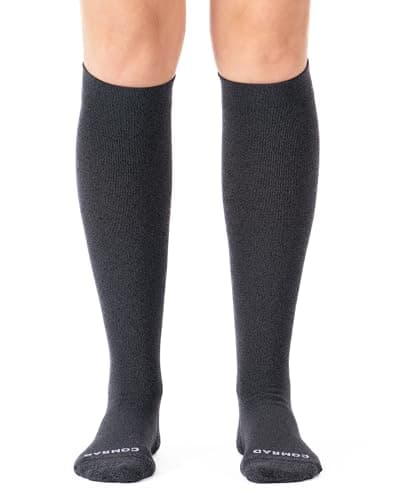 Comrad Knee-High Compression Socks (15-20 mmHg) 15-20 mmHg - firm enough to feel, mild enough to wear for twelve hours without resenting it. | A first pair, and long-haul economy | $33.99View on Amazon #ad Price as of November 3, 2026. How we’re funded |
| 2 | 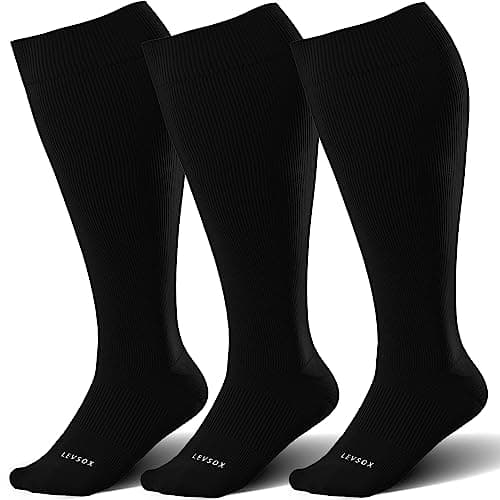 Wide Calf Compression Socks (15-20 mmHg) Same 15-20 mmHg band in a wider cut, so the gradient stays correct instead of inverting at the top. | Anyone whose calf measures past a standard size chart | $27.99View on Amazon #ad Price as of November 3, 2026. How we’re funded |
| 3 | 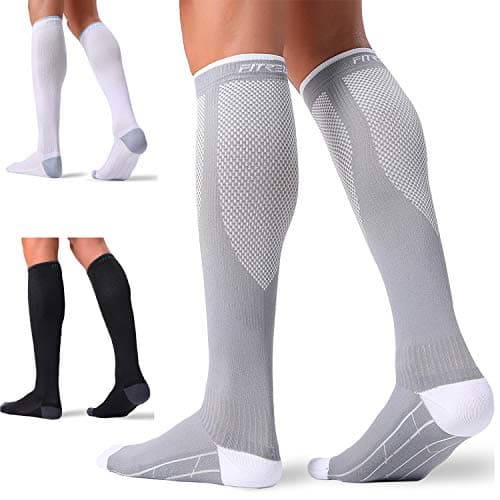 FITRELL Compression Socks (3 Pairs, 20-30 mmHg) 20-30 mmHg in a three-pack - the next band up, and noticeably harder to get on. | People already told which class they need | $14.99$26.9944% offView on Amazon #ad Price as of November 3, 2026. How we’re funded |
The class most people should start in
Comrad Knee-High Compression Socks (15-20 mmHg)
This is the band that works for the ordinary case: a long flight, a day of standing, swelling you noticed on the last trip. It is firm enough that you can feel the gradient but mild enough to put on in the morning and forget, which matters because the pair you find uncomfortable is the pair you leave in the drawer. The knit is also fine enough to pass as a normal sock.
The specs that decide it
- Compression: 15-20 mmHg - the usual travel band
- Height: Knee-high, which is what the gradient is designed around
- Feel: Firm and even, tightest at the ankle
- Sizing: By shoe size and calf circumference - measure both
Flaws but not dealbreakers
The sizing runs standard, so a wider calf will get a top band that digs in - and that is a fit problem the compression class cannot fix. They are also expensive for a sock, and they need gentle washing to keep the elastane alive.
#ad Price as of November 3, 2026. How we’re funded
The same compression, cut for the leg it is going on
Wide Calf Compression Socks (15-20 mmHg)
If a standard pair leaves a ring above your calf, the answer is a wider cut rather than a lower compression. A sock stretched past its design width is tightest where it is most stretched - at the widest part of the calf - which inverts the gradient the sock exists to create. Same 15-20 mmHg, correct geometry, and comfortable enough to actually keep on.
The specs that decide it
- Compression: 15-20 mmHg, same as a standard pair
- Cut: Wider calf panel, so the band does not bite
- Fixes: The dig-in at the top, which is a width problem not a class problem
- Measure: Calf circumference at its widest point, first thing in the morning
Flaws but not dealbreakers
Wide-calf ranges are narrower on colour and style, and a wide-calf sock on an average calf is too loose to deliver its stated compression - this only works if you have measured.
#ad Price as of November 3, 2026. How we’re funded
The firmer class, in a multipack
FITRELL Compression Socks (3 Pairs, 20-30 mmHg)
Included because some people have been told to wear 20-30 mmHg and want a travel pair of them. If that is you, a multipack is the sensible purchase - compression knits lose their elastane with washing, and three pairs rotated last longer than one pair worn constantly. If nobody has told you to wear this class, start at 15-20 instead.
The specs that decide it
- Compression: 20-30 mmHg - firmer than the usual travel band
- Pack: Three pairs, so they can be rotated
- Getting them on: Significantly harder than 15-20; a donner helps
- Before buying: This class is a clinical choice - ask, do not guess
Flaws but not dealbreakers
This is the band people most often buy without being advised to, and if you do not need it the result is a sock that is a struggle to put on and uncomfortable to fly in. The multipack build quality is also plainer than the single-pair brands.
#ad Price as of November 3, 2026. How we’re funded
Frequently asked questions
How tight should compression socks be?
What mmHg compression socks are best for flying?
Why do my compression socks dig in at the top?
Read next
- Best compression socks for flying
- Best compression socks for wide calves
- Long-haul flight essentials
- How to sleep on a plane
- Travel essentials for women over 50
- Travel essentials for men
More in Travel Essentials, or see every roundup and comparison on the site.