The best carry-on luggage for men
Most luggage sold as men's luggage is a dark colorway. What genuinely differs is the load, and the load is what these five are picked on.
By Michael W. · Last updated October 5, 2026
We earn a commission when you buy through our links, at no extra cost to you. It never changes what we pick or how we rank it. How we’re funded.
For most men flying with a laptop, a pair of dress shoes and clothes for three to five days, the Travelpro Platinum Elite 21-inch is the carry-on to buy - it clears the 22 x 14 x 9 inch standard used by American, Delta, United, JetBlue and Alaska, it is softside so it gives slightly at a strict gate, and the external access means the laptop comes out at security without a repack.
There is no engineering difference between men's and women's luggage. The marketing difference is a color. The real difference is the load: a men's packing list skews toward a laptop, larger shoes that eat volume no folding technique recovers, and often a jacket or suit that has to come out wearable. Those three things change which bag is right, and none of them are solved by buying something black.
All five picks below are already assessed elsewhere on this site. What is new here is the ranking: each one is placed by how it handles that load, not by how it photographs.
Quick picks
The short list. Tap any row for the full write-up, including what each one is bad at.
| # | Product | Best for | Price |
|---|---|---|---|
| 1 | 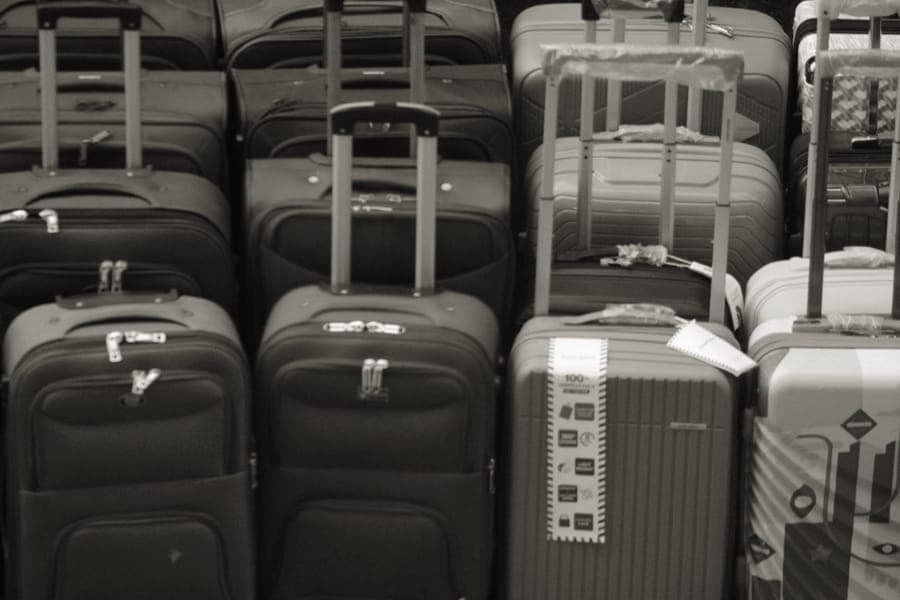 Travelpro Platinum Elite 21-inch Expandable Carry-On Spinner Softside, carry-on legal unexpanded, and the laptop comes out without unpacking. | Business and mixed trips | |
| 2 |  Samsonite Freeform Hardside Carry-On Spinner A light hardshell with a split-case interior that packs evenly on both sides. | Camera gear, bottles, anything fragile | |
| 3 |  Tortuga Travel Backpack 40L A squared clamshell pack with a separate laptop compartment, carried not rolled. | Trains, old cities, walk-ups | |
| 4 |  Patagonia Black Hole Duffel 40L Frameless and coated, so it takes the shape of whatever space it is given. | Gym kit, boots, wet gear | |
| 5 |  Amazon Basics 20-inch Hardside Spinner Smaller than the legal maximum on purpose, which is the whole point. | Occasional flyers and low-cost carriers |
The one for the trip where a laptop comes out at security
Travelpro Platinum Elite 21-inch Expandable Carry-On Spinner
The default case: three to five days, a laptop, one pair of shoes beyond what you are wearing, and a jacket you would rather not fold twice. Softside construction matters more than it sounds at a strict gate, because a fabric bag gives half an inch under a firm push where a shell simply does not.
The specs that decide it
- Clears: The 22 x 14 x 9 standard on American, Delta, United, JetBlue and Alaska
- Construction: Softside, which compresses slightly in a gate sizer where a hardshell will not
- Expansion: Expandable - but note that Alaska counts expansion toward the measurement
- Jacket carriage: Fold once over the packed contents, not twice into the base
Flaws but not dealbreakers
Use the expansion zip and the bag is no longer carry-on legal. It is genuinely useful for the trip home with a checked bag, and a trap if you forget you opened it. Softside also means the shell offers less protection if something fragile is inside.
The one when the contents matter more than the margin
Samsonite Freeform Hardside Carry-On Spinner
Choose the shell when what is inside is worth protecting and the bag will spend time in an overhead bin with other people's luggage pressed against it. A polypropylene-type shell does not transmit a knock the way fabric does, and it keeps rain out of a bag you walked three blocks with.
The specs that decide it
- Size: Carry-on spec against the 22 x 14 x 9 standard
- Shell: Polypropylene-type hardshell - light for the category, water-resistant
- Interior: Split-case clamshell, which packs flat and evenly on both sides
- Trade-off: Still heavier empty than any softside bag on this page
Flaws but not dealbreakers
A hardshell has no give - half an inch over and there is no pushing it into the sizer. The split-case design also needs floor space to open, which is awkward in a small hotel room or a train compartment, and light-colored shells scuff visibly.
The one when the trip has stairs in it
Tortuga Travel Backpack 40L
Trips where the bag has to be carried for real stretches: station stairs, a walk-up apartment, cobbled streets, a connection made on foot. The squared shape is the practical advantage over a tapered hiking pack, because it uses the corners of the carry-on envelope that a tapered bag wastes.
The specs that decide it
- Laptop: Dedicated compartment, separate from the main clamshell
- Shape: Squared-off - uses the corners of the carry-on envelope a tapered pack wastes
- Capacity: 40 liters, which is a week with one laundry stop
- Harness: Adjustable, built for carrying a full load through airports
Flaws but not dealbreakers
A squared pack filled to capacity is heavy and sits away from your back, which is less comfortable than a tapered design over distance. It is also expensive for a bag with no wheels, and there is nothing to set down and roll when you are tired.
The one for loads that are not clothes
Patagonia Black Hole Duffel 40L
Weekends built around an activity rather than a hotel: climbing shoes, a wetsuit, hockey gear, work boots. A frameless coated duffel has no shape of its own to defend, so it goes into a trunk, a train rack or a gate sizer that would reject a rigid case of the same volume.
The specs that decide it
- Structure: Frameless - conforms to the space available
- Fabric: Coated and weather-resistant
- Carry: Handles plus removable shoulder straps
- Capacity: 40 liters - a weekend with room for what you bring home
Flaws but not dealbreakers
A duffel with no internal structure is a sack. Everything settles to the bottom, finding one item means unpacking several, and there is no laptop protection at all unless you add a sleeve. It is also uncomfortable to carry fully loaded.
The one that buys certainty at the gate for the least money
Amazon Basics 20-inch Hardside Spinner
Two or three flights a year, often on carriers that measure. Being under the published limit rather than exactly at it removes the one argument you cannot win at a gate, and at this price the capacity you give up costs less than a single gate-check fee.
The specs that decide it
- Clears: Every carrier in the comparison above, with margin
- Construction: Hardside, so it holds its shape in an overhead bin
- Trade-off: Smaller than the maximum legal size - less capacity by design
Flaws but not dealbreakers
You are giving up real capacity to buy margin. On a carrier that would have accepted a full-size 22-inch bag, that is volume you paid for and did not use. Budget hardside shells also scuff quickly, so it will look second-hand fast.
The five picks compared
| Pick | Type | Laptop handling | Carry-on standard | Best for |
|---|---|---|---|---|
| Travelpro Platinum Elite 21 | Softside spinner | External access pocket | Clears 22 x 14 x 9 unexpanded | The default business trip |
| Samsonite Freeform Carry-On | Hardside spinner | Inside the shell only | Carry-on spec, no give at the sizer | Protecting what is inside |
| Tortuga Travel Backpack 40L | Travel backpack | Dedicated compartment | Squared to the carry-on envelope | Stairs, trains, no elevator |
| Patagonia Black Hole Duffel 40L | Frameless duffel | None without a sleeve | Compresses into a sizer | Gear, gyms and awkward spaces |
| Amazon Basics 20-inch | Hardside spinner | Inside the shell only | Under the standard, with margin | Buying certainty for the least money |
What actually differs about a men's carry-on
Nothing structural. Suitcases are not built to a gendered pattern, and the 22 x 14 x 9 inch envelope is the same whoever is holding the handle. What changes is the contents, and there are three contents problems worth buying around.
- Shoes. A men's size 11 dress shoe is a brick. Two pairs beyond what you are wearing is usually the point at which a carry-on stops closing, and no packing technique recovers that volume - the only fixes are fewer pairs or shoe bags that stop them fouling clothes while they take the space they take.
- The laptop. It has to come out at security on most lanes, and it has to go back in without repacking the bag. External access or a dedicated compartment is worth more in practice than any interior organization feature.
- The jacket or suit. A suit folded twice into the base of a bag arrives creased. Folded once over already-packed contents it usually arrives wearable - see how to pack a suit in a carry-on for the method.
Everything else that gets marketed at men - dark shells, leather-look trim, a brand with an expedition story - changes nothing about whether the bag fits or whether the suit survives.
Roll it or carry it?
This is the only genuinely difficult decision on the page, and the trip decides it rather than preference. A wheeled bag puts the weight on the floor, which is the right answer for airports, hotels and anywhere with elevators. A backpack keeps your hands free and does not care about stairs, gravel or a station with no lift, which is the right answer for trains and older cities.
The honest test: count the minutes on a typical trip where the bag is moving but not on a smooth floor. Under ten, buy wheels. Over thirty, buy straps. Between the two, buy wheels and pack lighter. Travel backpack vs suitcase works through the same decision in more detail.
If you have back or shoulder trouble
Buy wheels, and ignore any comparison that tells you a 40-liter pack is the versatile choice. Carrying 25 lb through a terminal is a different physical task from wheeling it, and no amount of harness engineering changes that.
Empty weight is the spec that decides international trips
US carriers generally do not publish a carry-on weight limit on domestic routes. Most international and low-cost carriers do, commonly 7 to 10 kg, and they enforce it. That reverses the usual buying logic: on a weighed allowance, every pound the empty bag weighs is a pound of clothes you cannot bring.
Hardshells cost you most here, which is why the Samsonite sits second on this page rather than first despite being the better bag for protecting contents. If a real share of your flying is on carriers that weigh cabin bags, buy the lightest bag that still holds its shape, and check the figure before you book - carry-on size by airline and cabin baggage size cover where the weight limits apply.
How we chose these picks
Each pick is a product already assessed on this site, re-ranked here against one question: does it handle a laptop, a pair of large shoes and a jacket inside a 22 x 14 x 9 inch envelope. Dimensions are checked against the carriers' own published figures rather than a retailer's description of a bag as carry-on size, which is a marketing claim and not a measurement.
We do not print prices on this site, because we do not run a live price feed for it - every buy link opens the current Amazon listing so the number you see is the real one at the moment you look.
What we passed over
- Luggage sets. The carry-on in a set is usually its weakest piece and the one you use most. Best luggage sets covers the one case where a set is good value.
- Oversize carry-ons built to the Southwest limit. A 24 x 16 x 10 bag is legal on Southwest and Frontier and oversize everywhere else. Buy to the strictest limit you fly regularly.
- Aluminum cases. They dent permanently, they are heavy against a weighed cabin allowance, and the look is the product.
- Anything called a weekender with no stated dimensions. If a listing will not give you three numbers, it is not a carry-on claim - it is a hope.
Frequently asked questions
Is there a difference between men's and women's carry-on luggage?
What size carry-on should a man buy?
Can you fit a suit in a carry-on?
Is a backpack better than a carry-on suitcase for men?
How many pairs of shoes should fit in a carry-on?
Sources
Read next
- Best carry-on luggage
- Best carry-on luggage for business travel
- How to pack a suit in a carry-on
- Carry-on size by airline
- Travel essentials for men
- Travel backpack vs suitcase
More in Luggage, or see every roundup and comparison on the site.