Best travel backpacks under $100
A travel backpack is the one bag category a tight budget barely hurts, because the expensive parts of a suitcase do not exist on it. Here is what that actually buys, and where the saving still shows.
By Michael W. · Last updated November 14, 2026
We earn a commission when you buy through our links, at no extra cost to you. It never changes what we pick or how we rank it. How we’re funded.
This is the one bag category where a hundred dollars is close to the ceiling rather than the floor. A wheeled suitcase under $100 is a compromise, because four wheel housings, a telescoping handle and a lock are the most expensive parts of a case and the money has to come out of one of them. A travel backpack has none of those parts. What you are buying is fabric, zippers, a harness and a pattern - and all four of those are good at this price in a way that running gear simply is not.
So the gap between a $45 travel backpack and a $300 one is real but narrow, and it is almost entirely in the harness and the fabric weight rather than in whether the bag works. That changes what you should be looking at. On a cheap suitcase the question is "what will break"; on a cheap backpack it is "will this be comfortable at hour six, and does it open the way I pack".
A price cap is a snapshot, not a promise
Every pick here was under $100 when the price layer last refreshed, with margin rather than by a dollar. Amazon prices move daily and colorways move independently of each other, so the buy button shows today's number rather than a figure typed into this article. If the color shown is over your budget, check the other colors of the same model before you look at another bag - it is frequently the same pack for noticeably less.
The criteria, in order
1) Does it open like a suitcase or like a hiking sack? A clamshell that lies flat is the single biggest usability difference at any price. 2) Is the harness load-bearing - padded, contoured shoulder straps and a sternum strap - or is it two flat webbing straps? 3) Does the packed bag stay inside the carry-on envelope, or does it only fit empty? 4) Where does the laptop go, and does that compartment lie flat at security? 5) Only then: pockets, colors and extras.
Quick picks
The short list. Tap any row for the full write-up, including what each one is bad at.
| # | Product | Best for | Price |
|---|---|---|---|
| 1 | 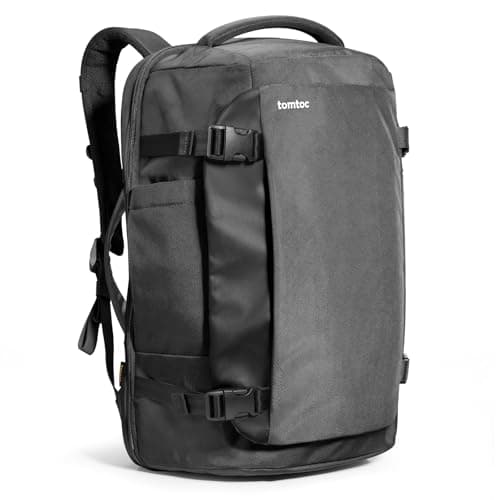 tomtoc Travel Backpack 40L A 40-liter, flight-approved clamshell that opens flat like a case and takes a 17.3-inch laptop, at four fifths of the cap. | Carry-on-only trips with no checked bag | $69.29$89.9923% offView on Amazon #ad Price as of November 26, 2026. How we’re funded |
| 2 | 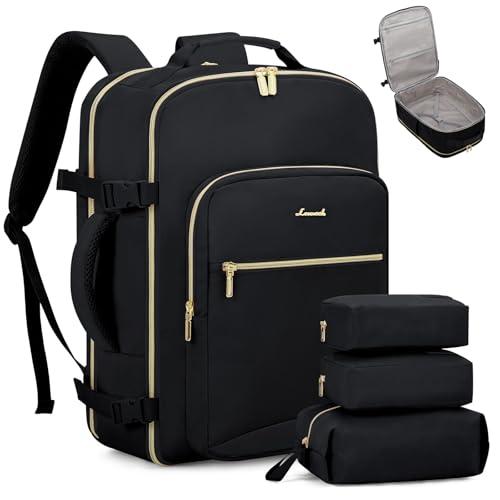 LOVEVOOK 40L Travel Backpack Flight Approved Carry on Backpack A 40-liter flight-approved clamshell that ships with three packing cubes and fits a 17-inch laptop, at under half the cap. | A first carry-on-only trip, kitted out in one purchase | $32.97$49.9934% offView on Amazon #ad Price as of November 26, 2026. How we’re funded |
| 3 | 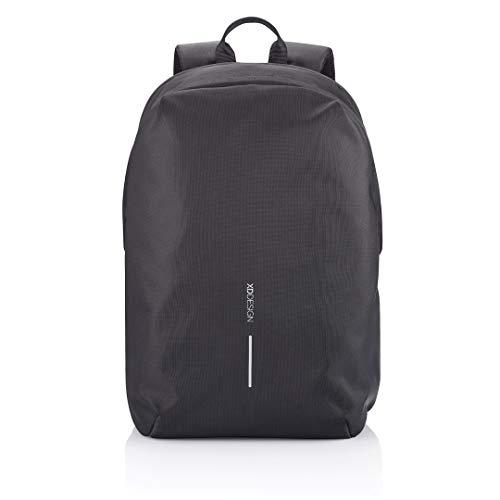 XDDesign Bobby Soft 16 Liter Anti Theft Laptop Backpack A 16-liter daypack with no outward-facing main zippers, an RFID-protected pocket and a padded 15.6-inch sleeve, just under the cap. | Crowded metros, day trips and the personal-item slot | $93.70View on Amazon #ad Price as of November 26, 2026. How we’re funded |
| 4 | 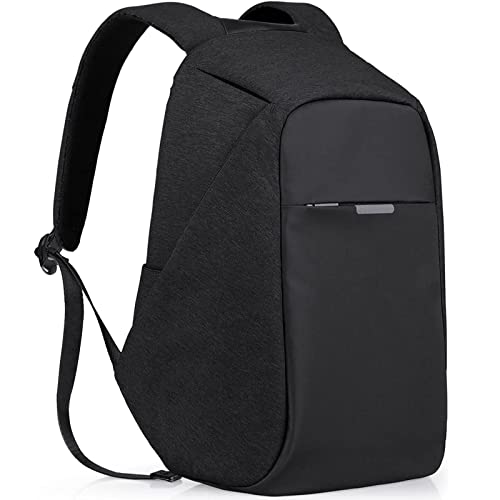 oscaurt Anti Theft Backpack 15.6 Inch Laptop Travel Backpack A hidden-zipper 15.6-inch laptop pack with a USB pass-through port and a water-resistant shell, at well under half the cap. | Buyers who want one bag for commuting and flying | $33.14$38.9915% offView on Amazon #ad Price as of November 26, 2026. How we’re funded |
| 5 | 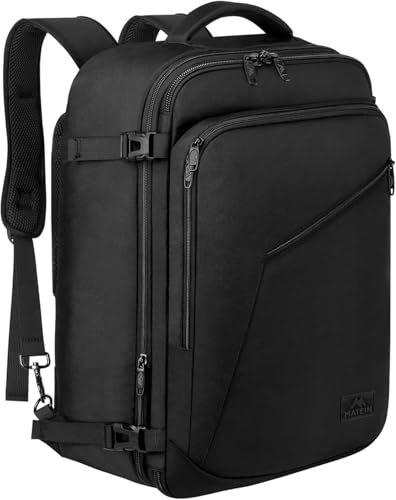 MATEIN Carry on Backpack, Extra Large Expandable Travel Backpack A 40-liter expandable airplane-approved pack at about a quarter of the cap - the cheapest honest way onto this list. | An overflow bag, or a first travel backpack on a tight budget | $23.99$43.9745% offView on Amazon #ad Price as of November 26, 2026. How we’re funded |
The one that is not held back by the budget at all
tomtoc Travel Backpack 40L
This is the pick that makes the argument of the page. Forty liters is the carry-on envelope rather than a hiking volume, the bag opens flat so you pack it in layers instead of digging down a tube, and the laptop compartment swallows a 17.3-inch machine - which in practice means it swallows any machine. It is also the most expensive bag here and still well short of the cap, so there is no sense of having scraped under a line. If you want one bag for a week away and you are willing to carry rather than roll, start here and stop here.
The specs that decide it
- Capacity: 40 liters
- Opening: Clamshell - lies flat like a suitcase
- Laptop: Fits up to 17.3 inches
- Listed as: TSA carry-on, flight approved, PFAS free
- Fabric: Water-resistant
- Price bracket: Upper end of the cap, with margin
Flaws but not dealbreakers
Forty liters sits at the very top of what most carriers will accept in the cabin, and a packed soft bag bulges in the dimension gate agents actually measure - depth. Pack it full and a strict agent with a sizer can still make it a problem, so read carry-on size by airline before you count on it. It also has no wheels, which on a long transit day is the whole experience rather than a footnote, and nothing structural to protect anything fragile inside.
#ad Price as of November 26, 2026. How we’re funded
The one that arrives with the packing cubes already in it
LOVEVOOK 40L Travel Backpack Flight Approved Carry on Backpack
The same format as the pick above - 40 liters, flight approved, clamshell, 17-inch laptop sleeve - for roughly half the money, and it comes with three packing cubes in the box. That bundle matters more than it sounds on a soft bag, because a backpack has no internal structure and cubes are what stop a packed pack from becoming one shifting heap. Buying a bag and a set of cubes separately at this budget would use most of the cap on its own, so for somebody kitting out a first carry-on-only trip this is the most complete thing on the page.
The specs that decide it
- Capacity: 40 liters
- In the box: 3 packing cubes
- Opening: Clamshell, carry-on sized
- Laptop: Fits up to 17 inches
- Fabric: Waterproof-rated outer
- Price bracket: Under half the cap
Flaws but not dealbreakers
The harness is where the saving against the pick above lands: the straps are thinner, there is less contouring, and 40 liters of packed weight tells you about it somewhere around hour three of a transit day. The included cubes are also sized to the bag rather than being a set you would buy on their own - they do the job in this pack and are unremarkable anywhere else. And like every 40-liter soft bag here, it is carry-on sized when sensibly packed and oversized when stuffed.
#ad Price as of November 26, 2026. How we’re funded
The one for a city where the bag is on your back in a crowd
XDDesign Bobby Soft 16 Liter Anti Theft Laptop Backpack
A different job from the two clamshells above: this is the bag you wear in a busy place rather than the bag you travel in. The main zippers sit against your back, which defeats the only theft that actually happens to most travelers - a hand in an outside pocket behind you on a packed train. There is an RFID-protected pocket for contactless cards, a padded 15.6-inch laptop sleeve, a water-repellent outer and a USB pass-through port. At 16 liters it also sits comfortably in the under-seat personal-item slot rather than fighting for the overhead bin.
The specs that decide it
- Capacity: 16 liters
- Zippers: Main compartment opens against the wearer's back
- Cards: RFID-protected pocket
- Laptop: Padded 15.6-inch sleeve
- Fabric: Water repellent
- Price bracket: Just under the cap
Flaws but not dealbreakers
It is the closest pick to the cap and the one most likely to cross it on a price move, so check the live number before you commit. Sixteen liters is also a daypack, not a travel bag - it will not do a week, or a weekend, and anyone expecting a smaller version of the 40-liter packs above will be disappointed by the volume. The back-panel opening means getting into the main compartment requires taking the bag off, which is the honest cost of the security and is mildly annoying several times a day. The USB port needs your own power bank; there is no battery in the bag.
#ad Price as of November 26, 2026. How we’re funded
The one that does the office and the airport on one budget
oscaurt Anti Theft Backpack 15.6 Inch Laptop Travel Backpack
This is the pick for someone who does not want a travel backpack and a work backpack. It has the same hidden-zipper idea as the Bobby Soft for a fraction of the money, a 15.6-inch laptop compartment, a USB pass-through port on the side and a water-resistant outer, and it looks like a business bag rather than a trekking bag - which matters if it is going into an office four days a week and onto a plane on the fifth. It is also the cheapest way onto this page if anti-theft zippers are the feature you actually came for.
The specs that decide it
- Laptop: Fits up to 15.6 inches
- Zippers: Hidden zipper main compartment
- Charging: USB pass-through port
- Fabric: Water-resistant
- Style: Business, not outdoor
- Price bracket: Well under half the cap
Flaws but not dealbreakers
The build quality is where you find the price: the fabric hand, the zipper pulls and the back panel are all a clear step below the Bobby Soft, and on bags in this bracket the zippers are what tire first under daily use. It is a laptop bag with travel features rather than a travel bag, so the main compartment is a single cavity without the structure a clamshell gives you. The USB port is a pass-through only - bring your own power bank - and the anti-theft design is a hidden zipper, not a cut-resistant panel.
#ad Price as of November 26, 2026. How we’re funded
The one to buy when the budget is a quarter of the cap
MATEIN Carry on Backpack, Extra Large Expandable Travel Backpack
Forty liters, expandable, airplane approved, water resistant, at roughly a quarter of the cap. There is no trick to how it is cheap: the fabric is lighter, the harness is simpler and the hardware is basic. What it does have is the right shape and the right volume, which is most of what a travel backpack needs to be. Buy it as a second bag that lives folded in a suitcase for the trip home, as a first travel backpack for somebody who is not yet sure they will carry rather than roll, or as a deliberately replaceable bag for a trip where you would rather not risk a good one.
The specs that decide it
- Capacity: 40 liters, expandable
- Listed as: Airplane approved, water resistant
- Build: Lightweight daypack construction
- Buy it as: A replaceable bag, not a ten-year one
- Price bracket: About a quarter of the cap
Flaws but not dealbreakers
Every corner that can be cut here has been. The straps are thin enough that a fully loaded 40 liters becomes genuinely uncomfortable within an hour, the expansion zip is the most likely failure point, and there is no meaningful warranty behind it. It is also a top-loading sack rather than a clamshell, so you pack it like a hiking bag and dig for anything at the bottom - packing cubes are close to mandatory rather than optional here. Treat it as a cheap, useful shape rather than a bag that will still be around in five years.
#ad Price as of November 26, 2026. How we’re funded
The five, side by side
| Backpack | Capacity | Opens flat? | Laptop | Best job | Price bracket |
|---|---|---|---|---|---|
| tomtoc Travel Backpack 40L | 40 L | Yes | 17.3 in | One bag for a week | Upper end of the cap |
| LOVEVOOK 40L | 40 L | Yes | 17 in | Carry-on-only, cubes included | Under half the cap |
| XDDesign Bobby Soft | 16 L | No | 15.6 in | Crowded cities, personal item | Just under the cap |
| oscaurt Anti Theft 15.6 | Daypack | No | 15.6 in | Commute plus occasional flight | Well under half |
| MATEIN Carry on Backpack | 40 L, expandable | No | Sleeve only | Overflow or first pack | About a quarter |
Why $100 goes further on a backpack than on a suitcase
It is worth being specific about this, because it is the whole reason the page exists and it is not obvious from a listing page.
- A suitcase has four wheel housings, a telescoping handle and usually a lock. Those three assemblies are the most expensive components on a case and the first three to fail. Under $100 one of them is cheap, and it is almost always the wheels - which is exactly where you least want the saving.
- A backpack has none of them. The bill of materials is fabric, zippers, webbing, foam and a pattern. All five of those are genuinely competent at this price, because they are made at enormous scale and there is no mechanism to cheapen.
- So the premium above $100 buys refinement, not function. Lighter fabric at the same strength, a better-shaped harness, load lifters, a warranty department. Real improvements, and none of them is the difference between a bag that works and one that does not.
- The exception is the harness under load. This is the one place a cheap pack genuinely is worse, and it is invisible in photographs. Thin, flat shoulder straps carry 40 packed liters badly, and you find out at hour three rather than on day one.
The practical version: if you are buying a bag you will carry for a couple of hours a trip, any pick on this page is fine. If you are buying a bag you will carry all day, spend toward the top of the cap and get the better harness - and if the bag has to roll instead, the best luggage under $100 sets expectations honestly across all the bag types at this budget.
Clamshell or top-loader? This matters more than the price
Two bags of the same volume at the same money can be completely different objects to live with, and the difference is how they open.
- A clamshell unzips around three sides and lies flat. You pack it in layers like a suitcase, you can see everything at once, and you can get at the bottom without unpacking the top. Travelers who switch from a top-loader tend to describe this as the upgrade, not the capacity.
- A top-loader is a tube with a lid. It is lighter and cheaper to make, it carries slightly better because the load sits closer to your spine, and anything at the bottom is effectively gone until you empty it. It is a hiking design being used for travel.
- Cubes narrow the gap but do not close it. Packing a top-loader in cubes turns "dig through everything" into "pull out three blocks", which is a real improvement and the reason the cheapest pick here needs them. A clamshell plus cubes is still better than a top-loader plus cubes.
The five-second test on any listing
Look for a photo of the bag open and flat on a bed. If the listing has one, it is a clamshell and the seller knows it is a selling point. If every photo shows the bag upright with the lid folded back, it is a top-loader. Nobody hides a clamshell.
The 40-liter trap, and how to stay out of it
Three of the five picks here are 40 liters, because that is the volume the whole category has converged on - it is the largest bag that can credibly be called a carry-on. It is also the volume that gets people stopped at the gate, and the reason is geometry rather than dishonesty.
A hard suitcase cannot exceed its own dimensions. A soft bag can, and does: fill 40 liters properly and the pack grows in depth, which is the dimension a sizer measures last and most strictly. The bag that measured legal empty in your hallway is a couple of inches deeper at the gate. That is not the manufacturer lying about the volume, it is a soft bag doing what soft bags do.
- Pack to the shape, not to the zipper. If you have to lean on the bag to close it, it is now a different size than the one on the listing.
- Use compression where the bulk is. Clothing is the compressible part of any load - compression packing cubes buy back depth specifically, which is the dimension that matters here.
- Know the number you are being measured against. The cabin allowance varies more than people expect, and the budget carriers measure. Carry-on size by airline has the current figures per carrier.
- Consider the personal-item slot instead. A 16-to-20-liter pack like the Bobby Soft goes under the seat without an argument, and on a short trip it is enough - see what counts as a personal item.
The features worth paying for, and the ones that are decoration
| Feature | Worth it? | Why |
|---|---|---|
| Clamshell opening | Yes, the most | Changes how you pack and unpack every single day of the trip |
| Padded, contoured shoulder straps | Yes | The one place a cheap pack is genuinely worse, and it only shows under load |
| Sternum strap | Yes | Costs almost nothing and takes real weight off your shoulders |
| Lay-flat laptop sleeve | Yes if you fly often | Lets the machine stay in the bag on a long security line - a convenience, never a guarantee |
| Back-panel or hidden zippers | Yes in cities | Defeats the theft that actually happens: a hand in an outside pocket in a crowd |
| USB pass-through port | Mostly no | There is no battery in the bag - it is a cable routed through a grommet, and your power bank does the work |
| "Anti-theft" with no material named | No | A cut-resistant panel is a specification. A slogan on the box is not |
| Rain cover included | Nice, not decisive | A water-resistant outer handles a shower; a cover handles a downpour and lives in a pocket until then |
Two of the picks above are sold on anti-theft features, so it is worth saying clearly what that means at this price: hidden or back-panel zippers and an RFID pocket, not slash-resistant fabric. That is still the right feature set for a crowded metro, because the realistic attack is a hand rather than a knife. If the trip genuinely calls for the harder stuff - a cut-resistant panel with the material named, zippers that lock to each other, an anchor strap - the best anti-theft travel backpacks ranks on exactly those three, and the honest answer there is that the full set costs more than this page's cap.
How to keep a pack under the cap when prices move
Every pick on this list had margin under $100 at the last refresh rather than squeaking under by a dollar, and that was deliberate - a price-capped page whose picks sit at $99 is wrong within a week. A bag that would otherwise belong here was left off for exactly that reason: the SwissGear 1900 ScanSmart sat within a dollar of the cap on the day this page was written. It is a good pack and it appears on the best luggage under $100, where one pick sitting at the line matters less because the cap is not the only organizing idea.
- Compare colorways before you compare models. The same pack routinely sells at different prices by color, because a shade that is not moving gets discounted. If the listed color is over budget, the identical bag in another color often is not.
- Check the size below. A 40-liter and a 35-liter version of one pack can sit either side of a price break, and the smaller one is more likely to clear a gate measurement anyway.
- Ignore the struck-through number. What matters is the price on the button today. A "was" figure on a marketplace listing is not a thing you can buy.
If a backpack is not actually the answer
Plenty of people land on a page like this because a suitcase felt like too much money, not because they want to carry their luggage. If that is you, the honest comparison is travel backpack vs suitcase, which is about the trip rather than the budget - wheels win on smooth terminals and lose on stairs, cobbles and trains. And if what you actually wanted was the premium carry-on you had priced up before the budget intervened, Monos luggage alternatives works through which part of that bag you can buy on its own for far less.
One band down, and what disappears
This page ranks on how a pack opens and how it carries. Halve the budget and the first of those survives intact while the second does not: at fifty dollars you still get the full forty liters and often a clamshell opening, but the harness - the contoured straps, the structured back panel, the hip belt - is exactly what the money was. Best travel backpacks under $50 says so plainly and ranks four packs on volume and shape instead.
Frequently asked questions
Is a travel backpack under $100 actually any good?
Will a 40-liter backpack fit as a carry-on?
What is the difference between a clamshell and a top-loading travel backpack?
Are the anti-theft backpacks at this price really anti-theft?
Do I need packing cubes with a cheap travel backpack?
Read next
- Best travel backpacks
- Best luggage under $100
- Best anti-theft travel backpacks
- Best carry-on backpacks
- Monos luggage alternatives
- Best compression packing cubes
- Carry-on size by airline
- Travel backpack vs suitcase
- What counts as a personal item
- Best travel backpacks under $50
More in Luggage, or see every roundup and comparison on the site.