How to measure carry-on luggage
Airlines measure the whole object. Manufacturers measure the case body. That gap is why a bag sold as carry-on fails a sizer, and five minutes with a tape fixes it.
By Michael W. · Last updated October 11, 2026

We earn a commission when you buy through our links, at no extra cost to you. It never changes what we pick or how we rank it. How we’re funded.
To measure carry-on luggage the way an airline does, stand the bag upright, fully packed, with the handle pushed all the way down, and measure the extreme outer points in all three directions - including the wheels, the handle housing and any external pockets. That total is the number that has to be under 22 x 14 x 9 inches on most US carriers.
Almost every carry-on problem traces back to one gap: manufacturers quote the case body, airlines measure the whole object. A suitcase marketed as a 21-inch carry-on frequently measures 22.5 inches once the wheels and the handle bracket are included, which is how a bag bought specifically to be legal gets stopped at a gate sizer. Five minutes with a tape measure before the trip is the entire fix.
Measure it packed, not empty
A softside case gains half an inch to an inch of depth when it is full, and the expansion zip adds more. Measure the bag in the state it will be in at the gate - packed, zipped shut, expansion closed.
What counts, and what does not
Airlines publish this in almost identical language, and the language is unambiguous. United, Alaska and Frontier all state that the measurement includes handles and wheels; Alaska adds explicitly that expandable pockets count as well.
- Counts: the wheels, the handle housing on the case exterior, external pockets, side feet, and the bag's expanded depth if the expansion zip is open.
- Counts: anything strapped, clipped or hung on the outside of the bag at the moment it is measured.
- Does not count: the telescoping handle in its extended position, and a luggage tag.
- Does not count in the US on most carriers: weight. Most US airlines publish no carry-on weight limit; most international ones do.
Why a 21-inch bag measures 22.5 inches
Luggage is marketed on the height of the case body, because that is the number that lets a manufacturer call a bag a 21-inch carry-on. Spinner wheels add roughly 1 to 1.5 inches underneath, and the handle bracket adds a fraction on top. A 21-inch body is therefore commonly a 22.5-inch object, which is over the 22-inch standard.
This is why listings that quote one number should be read as the optimistic one and why a 20-inch body is the safe purchase for strict carriers. What size suitcase is a carry-on covers the 21-versus-22-inch decision in full, and suitcase sizes in inches maps the common body sizes onto real overall figures.
What a gate sizer actually tests
A sizer is a metal box, usually cut to the airline's published limit with little or no tolerance. The test is whether the bag drops in and comes out again without being forced. That is a slightly different test from a tape measure, and it favours soft bags: a softside case half an inch over will compress into the frame, where a rigid shell half an inch over simply stops.
It also means a packed bag can pass in the morning and fail on the way home, because souvenirs changed its shape. If you are returning with more than you left with, measure again before the return leg.
Converting to centimetres for international flights
Multiply inches by 2.54. The US standard 22 x 14 x 9 inches is 56 x 36 x 23 cm, which is why that triplet appears on so many European carrier pages - the two standards are close but not identical, and the European figure is often a centimetre tighter on one dimension.
Some carriers also publish a linear limit - length plus width plus height, commonly 45 linear inches - and a bag can pass the individual dimensions while failing the total if it is unusually deep. International carry-on dimensions has the per-region figures.
Quick picks
The short list. Tap any row for the full write-up, including what each one is bad at.
| # | Product | Best for | Price |
|---|---|---|---|
| 1 | 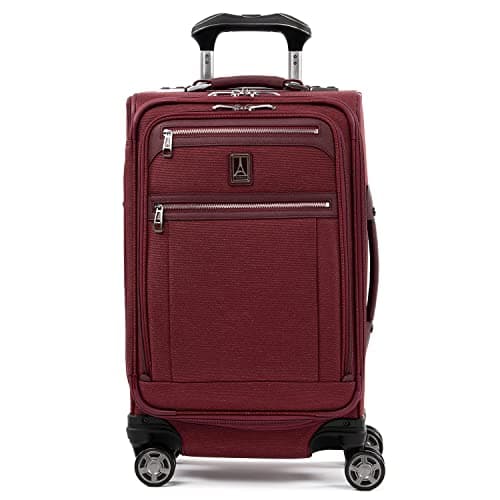 Travelpro Platinum Elite 21-inch Expandable Carry-On Spinner Built against the 22 x 14 x 9 standard as an overall figure, not as a case-body figure. | Frequent flyers on mixed carriers | $389.99View on Amazon #ad Price as of October 10, 2026. How we’re funded |
| 2 | 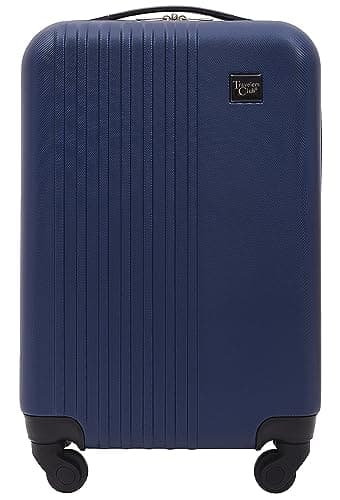 Travelers Club Cosmo 20-inch Hardside Spinner A 19.5-inch body, so even with wheels and handle it is inside every carrier's limit. | Ultra-low-cost carrier flyers | $39.00View on Amazon #ad Price as of October 10, 2026. How we’re funded |
| 3 | 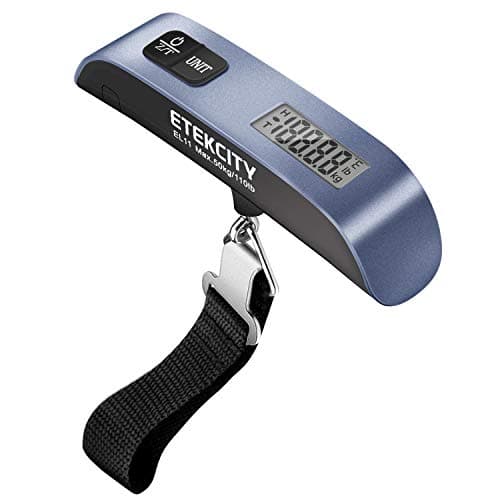 Etekcity Digital Luggage Scale Dimensions are only half the rule abroad - plenty of carriers weigh the cabin bag too. | International and weight-capped routes | $9.86$10.9910% offView on Amazon #ad Price as of October 10, 2026. How we’re funded |
The bag whose real measured size matches the standard
Travelpro Platinum Elite 21-inch Expandable Carry-On Spinner
If you would rather not measure anything, buy a case designed against the overall standard rather than against a marketing number. This one is built to clear 22 x 14 x 9 on American, Delta, United, JetBlue and Alaska with the wheels and handle included, and it is softside, so it compresses a fraction under a firm push at a tight gate where a hardshell simply will not.
The specs that decide it
- Clears: The 22 x 14 x 9 standard on American, Delta, United, JetBlue and Alaska
- Construction: Softside, which compresses slightly in a gate sizer where a hardshell will not
- Expansion: Expandable - but note that Alaska counts expansion toward the measurement
- Measure: Measure it packed and unexpanded, as described below
Flaws but not dealbreakers
Use the expansion zip and the bag is no longer carry-on legal - genuinely useful for the trip home with a checked bag, and a trap if you forget you opened it. Softside also means less protection if it does get gate-checked.
#ad Price as of October 10, 2026. How we’re funded
The one that is inside the limit before you measure it
Travelers Club Cosmo 20-inch Hardside Spinner
On an ultra-low-cost carrier the sizer is a revenue instrument and it will be used. Buying a bag that is comfortably inside the limit rather than exactly at it is the cheapest insurance available, and at this price it owes you nothing after a few trips. Measured overall it still clears every carrier in our size table with margin to spare.
The specs that decide it
- Clears: A 19.5 x 13.5 x 8.5 in body - inside every major carrier's limit
- Construction: ABS hardshell, 6 lb empty, so it holds its shape in an overhead bin
- Trade-off: A 19.5-inch body is smaller than the legal maximum - less capacity by design
- Measure: Still measure it: wheels add to the 19.5 in figure
Flaws but not dealbreakers
You are giving up real capacity to buy margin, and on a carrier that would have accepted a full-size 22-inch bag that is volume you paid for and did not use. Budget hard shells also scuff quickly.
#ad Price as of October 10, 2026. How we’re funded
The one that catches the limit nobody measures
Etekcity Digital Luggage Scale
US carriers mostly publish no carry-on weight limit, so Americans learn to think about inches only. Most of Europe, Asia and the Middle East weighs cabin baggage at 7 to 10 kg, and that is enforced at the gate with a hook scale. A few ounces of luggage scale in the bag turns that from a surprise into arithmetic you did at home.
The specs that decide it
- Capacity: Typically up to 110 lb / 50 kg - well above any airline limit
- Units: Switches between lb and kg, which matters on international routes
- Weight: A few ounces - it costs you nothing to carry
- Use: Weigh the packed bag at home, then again before the return flight
Flaws but not dealbreakers
A handheld scale reads a pound or so differently depending on how steadily you hold it, so leave margin rather than trusting it to the ounce. It also needs a handle strong enough to hang the whole bag from, which rules out some soft duffels.
#ad Price as of October 10, 2026. How we’re funded
Frequently asked questions
Do wheels count when measuring carry-on luggage?
How do you measure a carry-on bag at home?
Does the extended handle count in the measurement?
What are standard carry-on bag dimensions?
Sources
Read next
- Carry-on size by airline
- What size suitcase is a carry-on?
- Suitcase sizes in inches
- International carry-on dimensions
- Best carry-on luggage
More in Airline Rules, or see every roundup and comparison on the site.